When you click on links to various merchants on this site and make a purchase, this can result in this site earning a commission. Affiliate programs and affiliations include, but are not limited to, the eBay Partner Network.
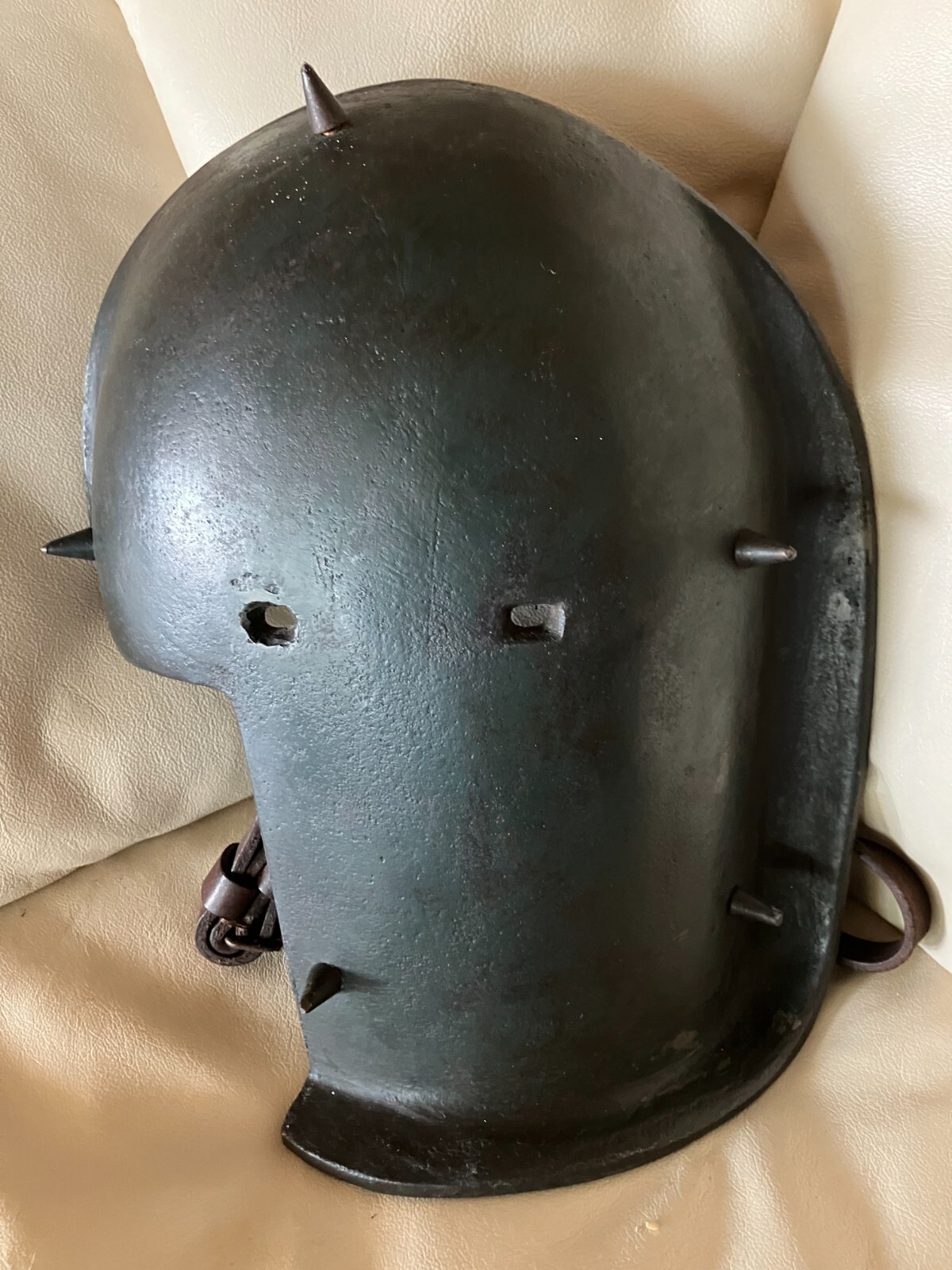
"Anoriginal German “Sappenpanzer Gesichtsmaske” or “Elephant Plate” (Schutzchild) armoredfaceplate as issued to snipers and machine-gunners in static positions on theWestern Front, by far the rarest of all pieces of German trench-amour. A veryheavy item made of Krupp hardened steel and strapped to the head by a cage. Itwas developed in response to the high number of facial-injuries suffered bysnipers and machine-gunners in the trenches during the First World War but onlyabout 1500 were manufactured in 1915. Due to its weight, it could only be usedby personnel in fixed positions but would protect the face and head fromrifle-rounds and shrapnel shards at all but point-blank range. This one waspurchased in Ostend, Belgium which is near Flanders Field in 1995. It weights 6.14.2 lbs. or 3.120K. and it is the quintessential collector's item from WW-1 as only a few are known to exist today and are in museums in Germany and England. This mask shows that its original owner attempted to enlarge the eye hole in the RH side of the mask but due to the hardened Krupp Steel it appears he was not very successful. This personalizes the mask making it more desirable. There are some copies out there, but this one is not. Most of these masks were left to rust in the fields and the few remaining are aggressively collected by WW-1 enthusiasts.
Assessment of WWI German Steel Face Protection Mask
To whom it may concern,
I have examined photographs and a detailed description of a steel face protection mask attributed to German use during the First World War. The mask is of heavy cast/hardened steel construction, weighing approximately 3.12 kg (6.14 lbs), with five conical frontal projections (prongs) and two rectangular eye apertures. The interior shows age‑consistent patina and wear, and the hardware (including the removable prongs) exhibits crude, non‑precision threads typical of small‑batch wartime manufacture rather than modern machine production.
Notable features include an apparent period attempt to enlarge the right eye aperture from the inside, consistent with field modification to improve visibility. The leather suspension/strap system appears to have been replaced or reworked at some point in its life, which is common for surviving examples of this type of equipment.
According to the current owner, the mask was acquired in Ostend, Belgium, from a private collector in the mid‑1990s. The piece has remained in the same condition since that time, with no restoration or cleaning undertaken by the present owner.
Based on the construction, weight, patina, hardware characteristics, and the nature of the field modification, as well as the reported history of acquisition, it is my professional opinion that this mask is very likely an authentic First World War German steel face protection mask (often associated with sniper or forward‑position use), rather than a modern reproduction or fantasy piece.
This assessment is based on visual review of the provided images and information and is offered as a good‑faith professional opinion.
Sincerely,
Brian Watkins
Appraiser – Military & Historical Artifacts
Independent Expert on the JustAnswer Platform
Date: 8/22/2026_______


 ABOUT
ABOUT