When you click on links to various merchants on this site and make a purchase, this can result in this site earning a commission. Affiliate programs and affiliations include, but are not limited to, the eBay Partner Network.
Weight
9.1 g
0.0091 kg
0.32 oz
0.020 lb
45.5 carats
Dimensions
Longest side
40.26 mm
4.03 cm
1.58 inches
⸻
This piece comes from my personal collection, carefully kept as a natural mineral display specimen.
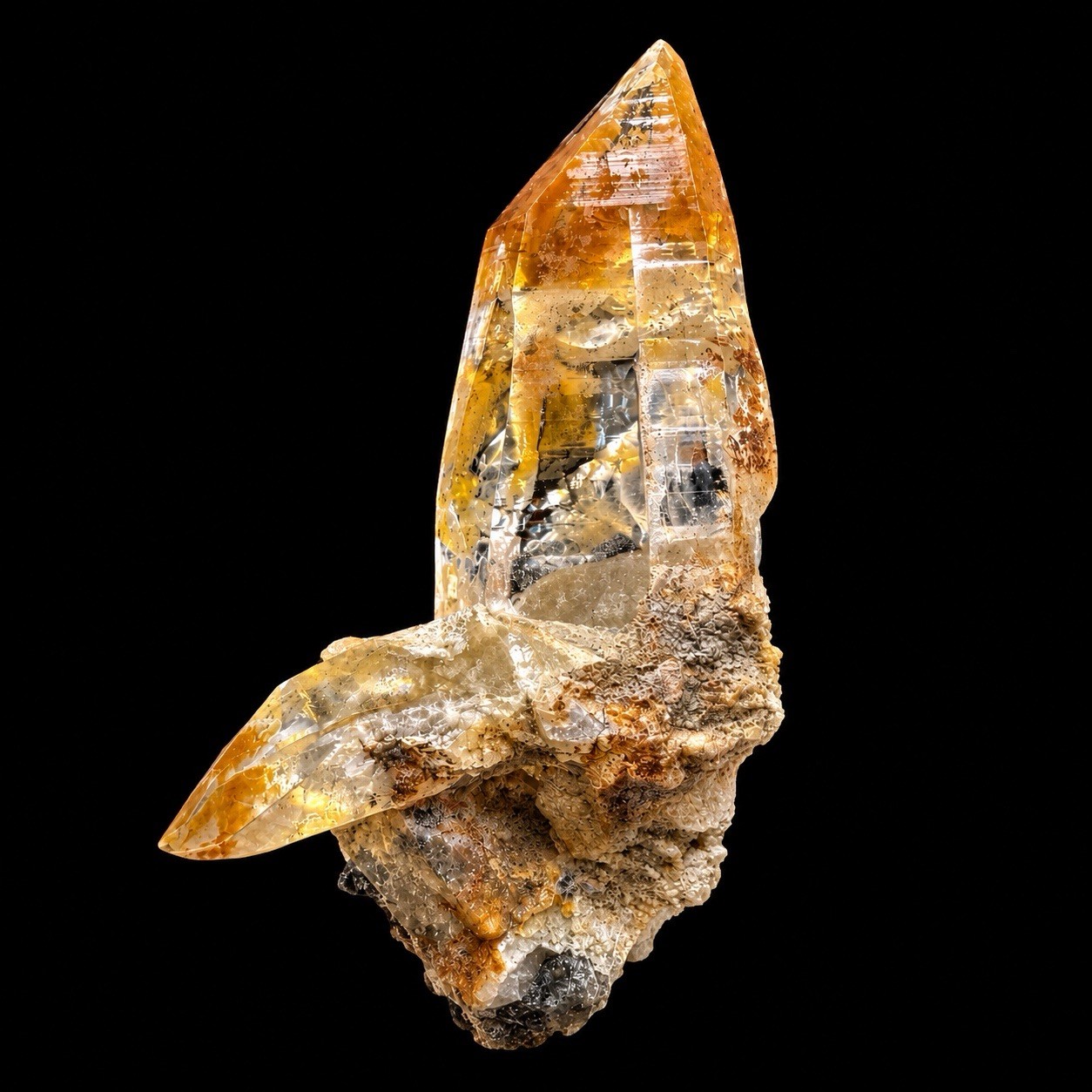
“Golden Guardian” is a natural golden Himalayan quartz specimen from Ganesh Himal, Nepal, distinguished by its charming figure-like formation, arm-like sidecar crystal, warm honey-golden coloration, remarkably transparent upper body, intricate circuit-board growth patterns, Akashic line textures, natural iron-oxide staining, mica inclusions, and complex mineral associations around the base.
The most distinctive feature of this specimen is its unusual natural silhouette. The tall main crystal forms a slender upright body, while a secondary crystal projects naturally from one side like a tiny arm or hand. From several viewing angles, the entire formation resembles a small standing figure, giving the specimen a highly recognizable and sculptural natural form.
The arm-like sidecar crystal is naturally integrated into the main crystal rather than appearing as a simple surface protrusion. Its defined crystalline form and warm golden termination create a beautiful visual balance with the taller main point and contribute strongly to the specimen’s “Little Guardian” appearance.
The main crystal rises into a sharp, well-preserved natural termination. Its elongated vertical form contrasts beautifully with the horizontally projecting side crystal, producing an unusually balanced silhouette despite the specimen’s small size.
The upper portion of the main crystal displays particularly impressive transparency. Large areas are glass-clear, allowing light to travel deeply through the quartz and reveal surface textures and internal features from different viewing angles. Some markings from the opposite faces can even be observed through the transparent body, creating a layered three-dimensional effect.
The lower portion gradually transitions into a softer, mistier interior. This natural cloud-to-clear transition creates a strong contrast between the cloudy lower body and the highly transparent upper section, giving the crystal noticeable visual depth from base to termination.
Warm honey-golden to amber-golden coloration is concentrated around the termination, selected growth areas, and portions of the side crystal. Rather than appearing as a uniform yellow body color, the golden tones occur selectively across the specimen, producing beautiful natural color zoning while allowing much of the quartz to remain highly transparent.
Across the main crystal faces are intricate circuit-board growth patterns characteristic of the specimen’s complex Himalayan growth history. Rectangular, stepped, and intersecting surface markings create an architectural appearance, with some areas resembling tiny geometric panels arranged across the crystal faces.
Fine Akashic line patterns and dense horizontal growth striations are also preserved along several prism faces. Under directional light, these closely spaced natural growth lines create subtle reflections and emphasize the crystal’s layered surface development.
Additional faces display stepped geometric growth, layered growth architecture, intersecting natural markings, and complex surface textures. Together, these features create a highly detailed surface rather than the simple smooth faces normally seen on more conventional quartz points.
The reverse preserves extensive natural golden-brown iron-oxide staining. In several areas, the staining forms irregular patches and map-like patterns across the crystal surface, producing a beautiful contrast between warm mineralized areas and the transparent quartz beneath them.
Natural mineral skin and original growth surfaces remain around portions of the lower body and intergrowth zones. These areas preserve a more rugged texture and provide a strong contrast with the glass-clear upper crystal faces.
Small mica inclusions and mica associations can be observed within and around the quartz. Together with natural internal veils, cloudy inclusions, and fracture planes, they create subtle internal scenery while preserving the exceptional clarity of the upper portion.
The interior also contains delicate reflective planes and wispy textures that become more visible as the crystal is rotated under light. These internal features create changing layers of depth between the clear upper chamber and the mistier lower section.
The area where the main crystal and sidecar crystal meet preserves a particularly complex natural intergrowth zone. Fine crystalline textures, mineral skin, iron staining, and irregular growth surfaces are concentrated around this area, recording the interaction between the crystals during their natural formation.
The base remains naturally mineralized rather than being cut or polished flat. Small golden crystal points are preserved around the lower area together with contrasting dark to black mineral associations, creating a striking visual transition from the warm golden quartz above to the darker natural matrix below.
These dark mineral associations, golden micro-crystals, iron-rich surfaces, and remaining natural matrix give the lower section a rugged alpine character and preserve important evidence of the specimen’s original mineral growth environment.
Overall, “Golden Guardian” combines a naturally anthropomorphic formation, an arm-like sidecar crystal, a sharp golden termination, exceptional upper-body clarity, a cloud-to-clear internal transition, circuit-board growth patterns, Akashic lines, stepped geometric textures, natural iron-oxide staining, mica inclusions, internal veils, golden micro-crystals, dark mineral associations, and an original natural matrix base.
Its defining feature is the remarkable little-guardian formation—a tall transparent main crystal accompanied by a naturally projecting arm-like sidecar crystal. Combined with its warm golden termination and intricate Ganesh Himal surface textures, this unusual silhouette gives the specimen a distinctive personality and makes it immediately recognizable from multiple viewing angles.


 ABOUT
ABOUT