When you click on links to various merchants on this site and make a purchase, this can result in this site earning a commission. Affiliate programs and affiliations include, but are not limited to, the eBay Partner Network.
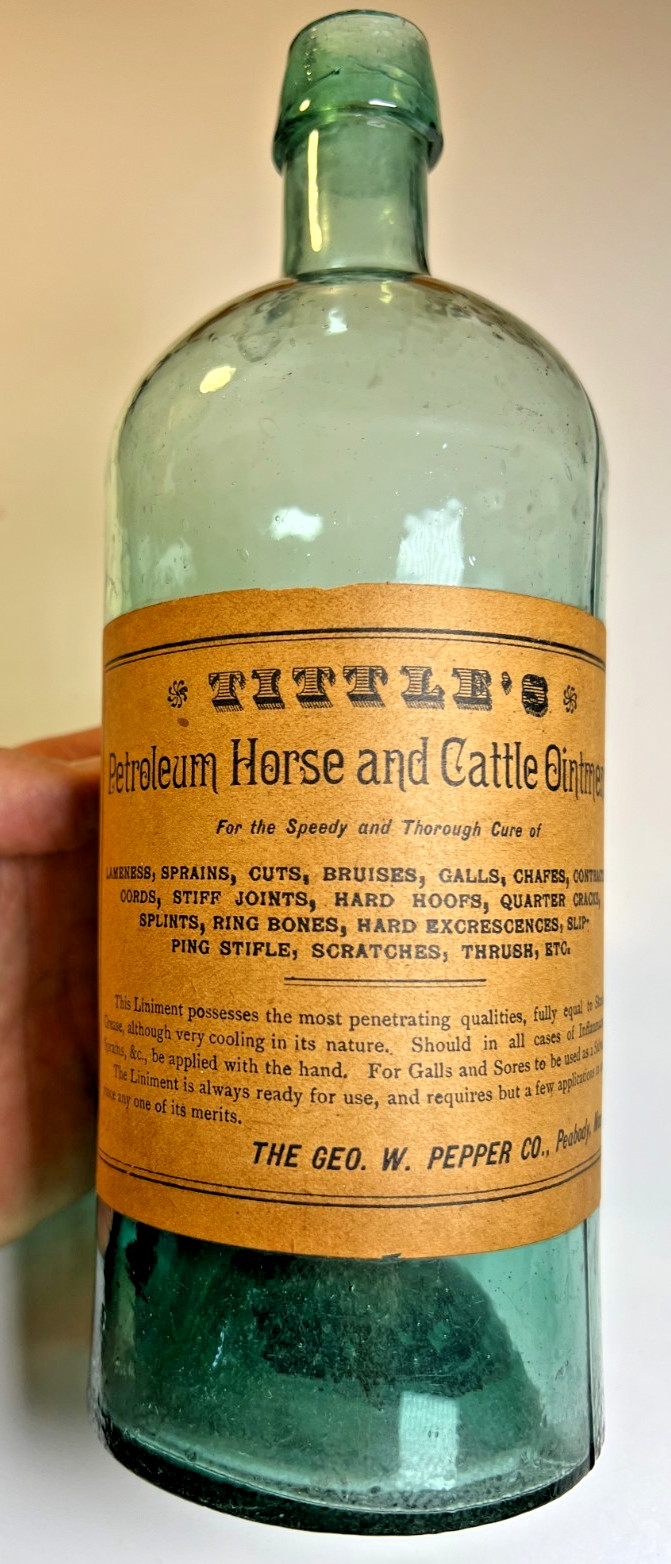
Few antique bottles preserve their original identity as completely—or as dramatically—as this extraordinary example. The beautiful rich teal glass, hand-applied top and dark iron residue on the high domed pontil immediately establish it as an early bottle. Yet it is the remarkable original wraparound label that turns it from an attractive piece of glass into a vivid artifact of American agricultural, veterinary and advertising history.
Standing approximately 9 3/8 inches tall, this bottle once held:
TITTLE’S
PETROLEUM HORSE AND CATTLE OINTMENT
Prepared and marketed by:
THE GEO. W. PEPPER CO.
Peabody, Mass.
Based upon the Peabody address, manufacturing characteristics and pontiled base, this bottle dates to approximately circa 1868–1872, most likely about 1870.
The Original Label
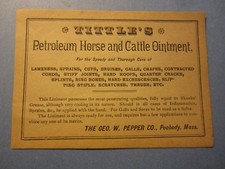
The wonderfully preserved label promises the “Speedy and Thorough Cure” of an almost astonishing list of equine and livestock complaints, including:
Lameness, sprains, cuts, bruises, galls, chafes, contracted cords, stiff joints, hard hoofs, quarter cracks, splints, ring bones, hard excrescences, slipping stifle, scratches, thrush, etc.
The instructions describe the preparation as possessing powerful penetrating qualities while remaining “very cooling in its nature.” It was to be rubbed on inflamed areas by hand and used as a salve for galls and sores.
One of the label’s most fascinating claims is that the preparation was “fully equal to Skunks’ Grease.” That curious comparison was not merely colorful Victorian salesmanship. Animal fats—including skunk grease—had long been used in folk and veterinary remedies as supposedly penetrating treatments for stiffness, swelling and soreness. By advertising a petroleum preparation as its equal, the company was presenting mineral oil as a cleaner, ready-made and commercially packaged modern replacement for an older country remedy.
What Was Inside?
The exact proprietary recipe does not appear on the label, but products of this kind generally combined a petroleum-derived oil or semi-solid petroleum base with grease, wax or other thickening ingredients. Some veterinary liniments also incorporated turpentine, camphor or aromatic oils to produce warmth, cooling sensation and a strong medicinal odor.
This was not intended as a dainty household medicine. It was a practical stable preparation—something a farmer, teamster, liveryman or carriage operator could reach for when an animal developed a sore shoulder, cracked hoof, swollen joint or harness gall.
Before automobiles and tractors, a sound horse was transportation, farm machinery and livelihood rolled into one. A lame animal could stop a delivery route, delay planting or harvesting, or leave a family unable to travel. A large bottle such as this was therefore a working necessity rather than a novelty.
The George W. Pepper Company
George W. Pepper belonged to the Pepper family associated with one of the North Shore’s oldest confectionery traditions. The family’s candy-making roots stretched back to the early nineteenth century, and George W. Pepper assumed control of the business in 1864. He moved production to the corner of Central and Elm Streets in what was then South Danvers and soon to become Peabody.
The Pepper concern became especially well known for confectionery and cigars, eventually developing into a substantial regional operation. The Peabody Historical Society records that the business reached annual sales of approximately $200,000 at its height—a very considerable sum for the nineteenth century.
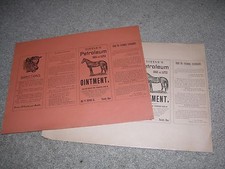
Tittle’s ointment reveals a particularly interesting and little-seen side of the company. The firm was evidently willing to market more than candy and tobacco, taking advantage of its manufacturing, printing and distribution network to sell a proprietary veterinary preparation. Historic New England preserves both a trade card and a broadside advertising this exact product, confirming that it received a genuine printed marketing campaign rather than being merely a short-lived handwritten or local apothecary preparation. Peabody Historical Society Historic New England
Why “Peabody” Helps Date It
The location printed on the label provides an unusually useful historical marker. The community was incorporated independently as South Danvers in 1855, but on April 30, 1868, its name was changed to Peabody in honor of locally born international banker and philanthropist George Peabody. Any original label reading “Peabody, Mass.” must therefore have been printed after that date. Peabody Institute Library
George Peabody died in London in 1869. In early 1870 his body was ceremonially returned to Massachusetts aboard the British warship HMS Monarch, and his funeral and burial became one of the greatest public events the young town had yet witnessed. This bottle was very likely made at almost precisely that moment, when the name “Peabody” was still new and the town’s famous namesake was receiving worldwide attention.
Peabody and America Around 1870
Peabody was then a vigorous industrial town rather than the modern city it would become in 1916. Tanneries, leather dressing, shoe-related trades, carriage shops, small factories and family farms all operated close together. Horses hauled hides, coal, food, manufactured goods and passengers through streets that could become dusty in summer and deeply muddy in spring.
Nationally, America was emerging from the Civil War and moving through Reconstruction. Ulysses S. Grant entered the White House in 1869, the first transcontinental railroad was completed that same year, and telegraph lines were knitting distant markets together at unprecedented speed. Yet daily transportation remained overwhelmingly dependent upon horses.
Nearby Boston was expanding rapidly and would suffer the devastating Great Boston Fire of 1872. Industrial towns north of the city supplied Boston with leather goods, shoes, food, labor and manufactured products. A bottle of veterinary ointment from Peabody therefore belonged to the working machinery of that growing regional economy.
The Bottle
The bottle itself is an exceptional example of late pontiled American glassmaking. Its color ranges from aqua to a beautifully saturated rich teal, becoming especially deep around the heavy heel and base.
The surface displays wonderful handmade character, including scattered bubbles, waviness and attractive orange-peel texturing, particularly around the heel. The neck carries a substantial hand-applied top, while the high domed base retains a broad, dark iron pontil scar with original metallic residue.
That pontil is especially desirable. It records the final step in the bottle’s manufacture, when an iron pontil rod was attached to the base so the glassworker could finish the mouth by hand. When the rod was broken away, it left behind the rough dark scar visible today.
Condition
Excellent antique condition. The glass is bright, clean and visually brilliant, with no chips, no cracks, no haze and no spotting.
There are two tiny open air bubbles located along the shoulder mold seam, both entirely original to manufacture. Faint dust remains on the interior floor.
The rare original wraparound paper label is exceptionally complete for its age. It shows only faint losses and minor wear around some corners and edges. The central printing remains dark, crisp and remarkably easy to read.
The bottle is empty.
Measurements
- Height: Approximately 9 3/8 inches
- Color: Rich teal aqua
- Top: Hand-applied
- Base: High domed iron pontil with metallic residue
- Label: Original wraparound paper label
- Date: Circa 1868–1872; most likely circa 1870
- Origin: Peabody, Massachusetts
This is considerably more than an attractive pontiled bottle. It survives with its original name, purpose, maker and place of manufacture intact—combining early American glass, veterinary medicine, petroleum history, agriculture and the story of one of Peabody’s notable family businesses in a single beautifully preserved object.


 ABOUT
ABOUT